

Your agency builds showcase sites for clients who expect a premium look and performance in line with current best practices, especially for accessibility and SEO and GEO visibility. One question follows: how do you industrialize production to protect your margins, while making sure every site is perceived as unique and high-end?
The pull of the template is strong. You buy a theme, change the colors and deliver in two days. The problem comes six months later, when the platform you use (such as WordPress) and the plugins needed to meet your clients' requirements release new versions, and the template turns out to be incompatible with the upgrades.
Templates and site factories are not the same thing
A template is a fixed visual skeleton. You can change the colors and images, but the page structure, the block hierarchy and the behavior of the components stay identical from one client to the next. It is a mass-market product dressed up as custom work.
A configurable website builder is a unified technical base that allows endless assembly. The components are the same, but their variations, combination, order, content and derived style produce a visually distinct site every time. It is the difference between a prefab house identical to ten thousand others and a modular building system that delivers different architectures from the same quality bricks.
Think in components for pages that don't look alike
With fourteen core components (banner, text, gallery, testimonial, form, FAQ and more), you can build an endless variety of pages. Each component has format variants (with or without an image, with or without a background, and so on) and style options that change its look while respecting the client's brand guidelines.
The same banner component can appear in a sober, corporate version on a law firm's site, then in an expressive version with an animated gradient on a boutique hotel's site. The structure is identical. The visual experience is completely different.
The client does not see the components. They see a smooth, consistent site that tells their story. The agency gains production speed without losing differentiation.
Another benefit: the client can manage and update their site easily, because the learning curve is minimal and there is no risk of breaking the site.
Web factories are built for quality
When a prospect visits your client's site, they judge its credibility within seconds. They don't know whether the site was built on Wix, WordPress or an in-house website builder. They do know whether the design is consistent, the typography is polished, the animations are subtle and the site responds instantly on mobile.
A website builder with built-in performance, WCAG AAA accessibility and self-adapting responsive layout sends a quality signal that visitors pick up on intuitively. That signal is your commercial advantage. It justifies a premium price even when your production cost is under control.
Which business model should you choose?
Consider an agency that delivers forty sites a year. With the template approach, it bills between three and fifteen thousand euros per site and spends several days adapting the template to the client's needs before building the pages and their content. The margin shrinks with every extra day, and future maintenance eats into your profit even more.
With a configurable website builder, you bill the same amount per site (while guaranteeing the benefits the platform provides, such as accessibility, performance and adaptation to every screen format) and spend your time on content and client strategy. You deliver faster, you can commit to quality, and the result is predictable and easy to modify. You deliver more and better, with no surprises.
The model works because the end client perceives value. They don't perceive standardization.
Look at what your licenses include
Depending on your production volume, what you get with your website builder license lets you recoup the initial investment quickly. With or without access to the source code? With or without automatic updates whenever the platform evolves? A set number of sites per year from the website builder, or unlimited?
In every case, the license gives you full use of the tool's features. The agency is not locked in. If the license includes access to the source code, it can evolve the stack with its own developers. This is a fundamental difference from SaaS platforms, which hold clients through their data and architecture. Your platform should also be easy to deploy and easy to use, so that it works for a general audience too and avoids frustrating your users whenever a new page has to be added.
The Lugor solution for your next websites
Lugor was designed to give web agencies a technically mature, easy-to-use solution that offers the features large corporations expect to companies that lack the in-house skills to ask for them. It comes with twenty core components that can be assembled endlessly, and a derived design system that calculates more than eight thousand lines of CSS from your clients' brand colors and fonts. These settings produce sixteen visual atmospheres to set one site's look apart from another's. Every site is delivered with Lighthouse scores of 100/100 for SEO, 100/100 for accessibility and 100/100 for best practices by default, with a performance score target above 90 on desktop. These results are verified at every deployment and backed by 1,600 audited criteria (56 WCAG 2.2, 102 SEO and GEO of which 18 are specific to AI engines, 10 OWASP 2025, 1,331 unit tests). The license is on-premise, with no volume-based subscription. Several license options match your agency's production volume. The details of the benefits and the technical architecture are documented on the dedicated pages. To see Lugor in action and explore our offers, contact us to book a meeting.
Key takeaways
- A template creates homogenization. A configurable website builder creates uniqueness from standardized bricks.
- Fourteen components, assembled endlessly, cover the needs of premium showcase sites.
- Perceived quality (performance, accessibility, consistent design) justifies a premium price.
- Three license formats match the investment to the production volume.
- Handing code ownership back to the client removes the risk of lock-in.
- The end client's CMS reduces the support load and protects the agency's margin.
Frequently asked questions
Glossary
- White label
- A product or service made by one company and resold under another company's brand. Here, a website built by an agency on behalf of a client who in turn resells it.
- Configurable website builder
- A unified technical platform that produces visually unique sites through configuration rather than development from scratch.
- Format variant
- A version of a component that changes its structure (with or without an image, full width or column, etc.) without changing its nature.
- Style option
- A different visual treatment applied to the same component (frosted glass, animated gradient, matte surface) while respecting the brand guidelines.
Sources
Related articles
 Website builder
Producing Premium Sites: A Focus on the Design System
A derived design system lets an agency deliver unique sites while cutting marginal cost and keeping a premium look.
 Website builder
Which Tech Stack for a Premium Web Agency in 2026?
Three technical approaches for an agency producing premium showcase sites at volume. A decision framework and the marginal cost over five years.
 Release notes
What's new in Lugor: October 2026
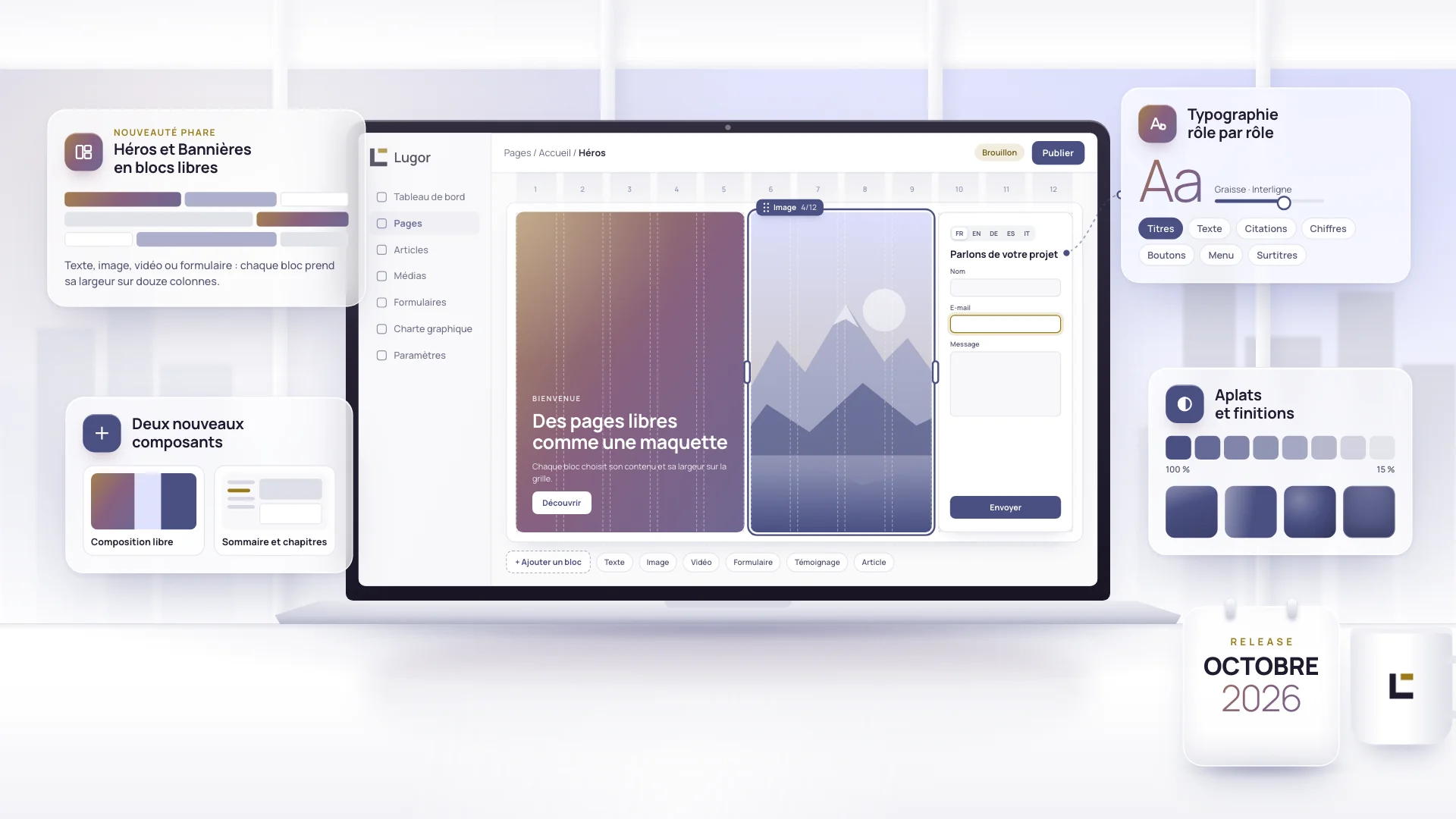
Lugor lets you build very fast sites with a layout as free as a custom build, without writing a line of code. The October release pushes that freedom further: your Heroes and Banners are built from free-form blocks, two new components arrive, and your brand guidelines now control typography role by role.