

Your agency manages a portfolio of WordPress sites, or sites on another tech stack. Constant plugin maintenance, security updates, site restores after a version upgrade and support tickets add up to a workload that eats into your margins. You know the situation is not sustainable. But changing stacks takes an investment in time and training that many agencies postpone until a major incident forces their hand.
The question is not whether WordPress is a bad tool. It remains relevant for many uses. The question is whether your business model, which relies on producing premium showcase sites at a steady volume, is compatible with an architecture that generates technical debt on every project.
Four technical approaches in 2026
Headless with a SaaS CMS
You keep WordPress or move to a modern headless CMS (Sanity, Contentful, Strapi) served through an API. The front end is rebuilt in React, Next.js or Svelte. Performance is excellent, front-end security is real, and the visual result can reach a premium level.
The first cost is developing and adapting the API for every client site you create, unless you standardize your development and accept the constraints of these CMSs.
The hidden cost is the volume-based subscription. When a client has a traffic spike, your CMS bill climbs. When you deploy fifty sites, you multiply the subscriptions. Dependence on the SaaS becomes a recurring cost line you don't control. On top of that, every developer must master the front end, the API and the CMS data model.
The proprietary full stack
You build your own technical framework on Laravel, Symfony or an in-house framework. You control every layer, you depend on no third-party vendor, and you can optimize each site to the extreme.
The risk is the bus factor. If your technical lead leaves, the stack becomes hard to maintain. If technical standards change, they will force a heavy refactoring of your stack. Internal documentation erodes, newcomers struggle to get up to speed, and every project rests on concentrated expertise. This approach works for an agency with a stable, senior technical team. It becomes fragile as soon as the team sees turnover, and over the long term, because it is often built alongside your billable projects and therefore always comes second.
Headless WordPress
You keep WordPress as the back office and rebuild the front end in Next.js. You remove part of the front-end performance and security problems while keeping the familiar editorial interface.
The structural problem remains. WordPress core still demands its security updates. Plugins remain weak points. You add a layer of complexity without solving the root cause of the technical debt. It is a compromise that eases the symptoms without treating the disease.
The website builder with a derived design system
You standardize the tech stack on a unified base (Next.js, a co-located CMS, a configurable design system) and derive the visual appearance from each client's brand guidelines. Every site shares the same technical foundation, but the visual result is unique.
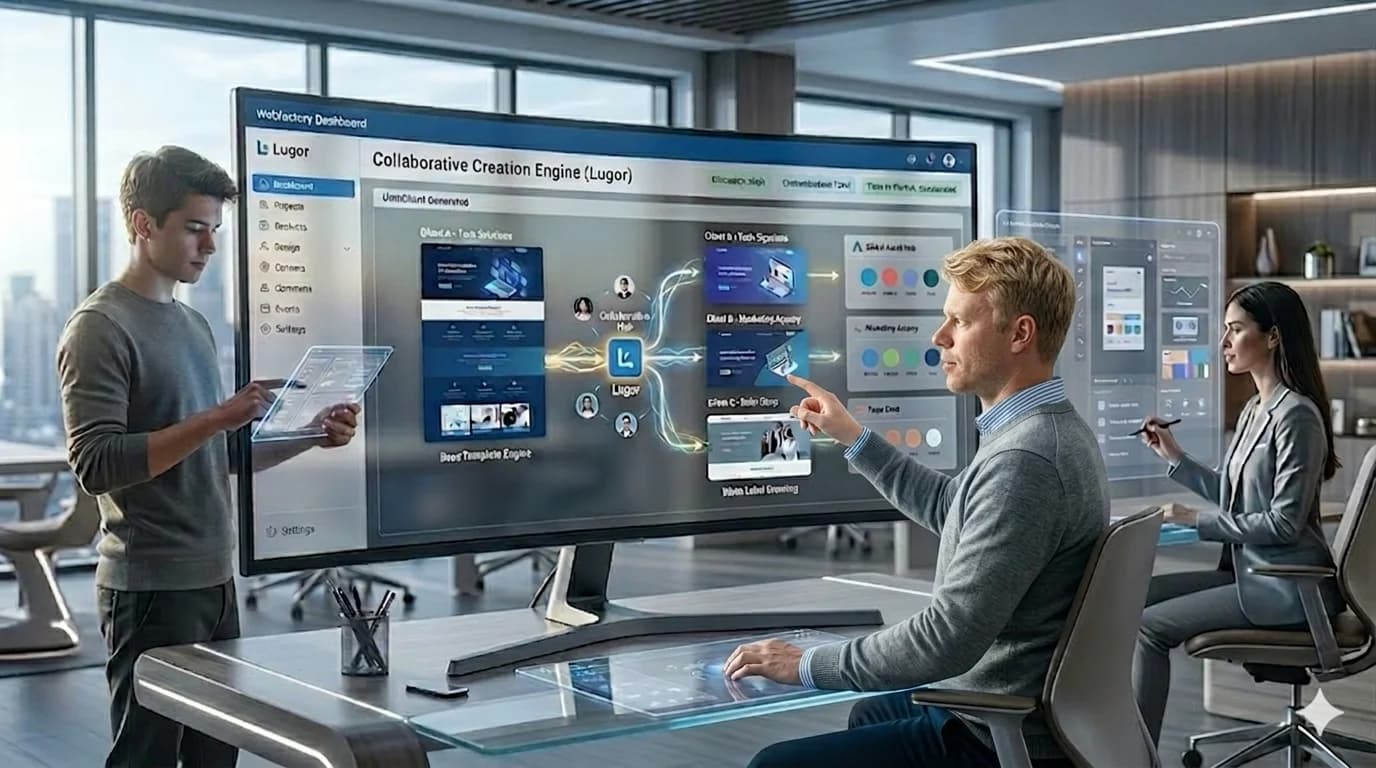
The initial investment is building the website builder or buying licenses. Once it is in place, every new site benefits from the same performance optimizations, the same security fixes and the same component updates. The marginal cost drops mechanically. The agency gains in profitability, predictability and quality, because this website builder was built for exactly that purpose.
A decision framework with four criteria
To choose between these approaches, ask yourself the following four questions.
First, the cost of migrating existing clients. What is the real budget to move your portfolio over? A stack that requires rewriting everything pushes the project back indefinitely. A stack that allows a gradual migration protects your cash flow.
Second, the learning curve. How many weeks does it take for a junior developer to become productive? If the answer is more than two months, the approach is risky for an agency that hires regularly.
Third, the maturity of the ecosystem. Does the technology have an active community, maintained documentation and strategic acquisitions that signal longevity? Next.js has four million developers. Payload CMS was acquired by Figma in June 2025.
Fourth, the risk of lock-in. Do you own the code? Can you walk away with it if the vendor disappears? A license that hands the code back to the client removes this risk.
What your stack choice changes for your business model
An agency producing twenty sites a year on WordPress typically spends between fifteen and twenty-five percent of its development time on corrective maintenance. That time is not always billed to the client, so it is absorbed by the margin.
When you move to a unified stack with a reduced attack surface and zero third-party plugins, that ratio falls below five percent. The difference amounts to hundreds of hours a year that you can win back for billable production or business development. This is not a marketing argument. It is a calculation every agency owner can run with their own numbers.
The solution Lugor offers
Lugor is built for the fourth case: the unified website builder with a derived design system. The stack relies on Next.js and Payload CMS co-located on the same server, with no network request between the CMS and the rendering. The design system is configured with four colors and two fonts, which automatically generate more than eight thousand lines of CSS, thirty ready-to-use components and sixteen visual atmospheres. Every site gets, by default, a Lighthouse score of 100/100 for SEO and accessibility, 1,600 criteria audited at every deployment (56 WCAG 2.2, 102 SEO and GEO of which 18 are specific to AI engines, 10 OWASP 2025, 1,331 unit tests) and an on-premise license with no volume-based cost. We have documented our architecture and the advantages of using Lugor. To evaluate what this change of stack would bring to your current portfolio, book a meeting through the contact page. We reply within forty-eight hours.
Key takeaways
- WordPress generates technical debt that eats into the margins of agencies working at volume.
- A SaaS headless CMS improves performance but creates a dependence on volume and a recurring cost.
- The proprietary full stack offers total control but concentrates risk on a few senior profiles.
- Headless WordPress is a compromise that does not remove core maintenance.
- The website builder standardizes the technology and derives the appearance, reducing the marginal cost.
- Four decision criteria: migration cost, learning curve, ecosystem maturity and lock-in risk.
Frequently asked questions
Glossary
- Headless CMS
- A content management system that separates the storage back office from the presentation front end. Content is served through an API instead of being rendered directly.
- Co-located CMS
- A CMS installed on the same server as the application code, with no network request between the two. This removes latency and volume-based cost.
- Derived design system
- A design system that automatically generates all the shades, spacing, interactive states and components from a handful of input variables (colors, fonts).
- Bus factor
- An organizational risk caused by skills being concentrated in a single person. If that person disappears, the project becomes hard to maintain.
Sources
Related articles
 Website builder
Choosing No-Code to Deliver a Unique, High-Performing Site
A white-label agency can industrialize without homogenizing. Business model, perceived quality and code ownership for 40 sites a year.
 Website builder
Producing Premium Sites: A Focus on the Design System
A derived design system lets an agency deliver unique sites while cutting marginal cost and keeping a premium look.
 Release notes
What's new in Lugor: October 2026
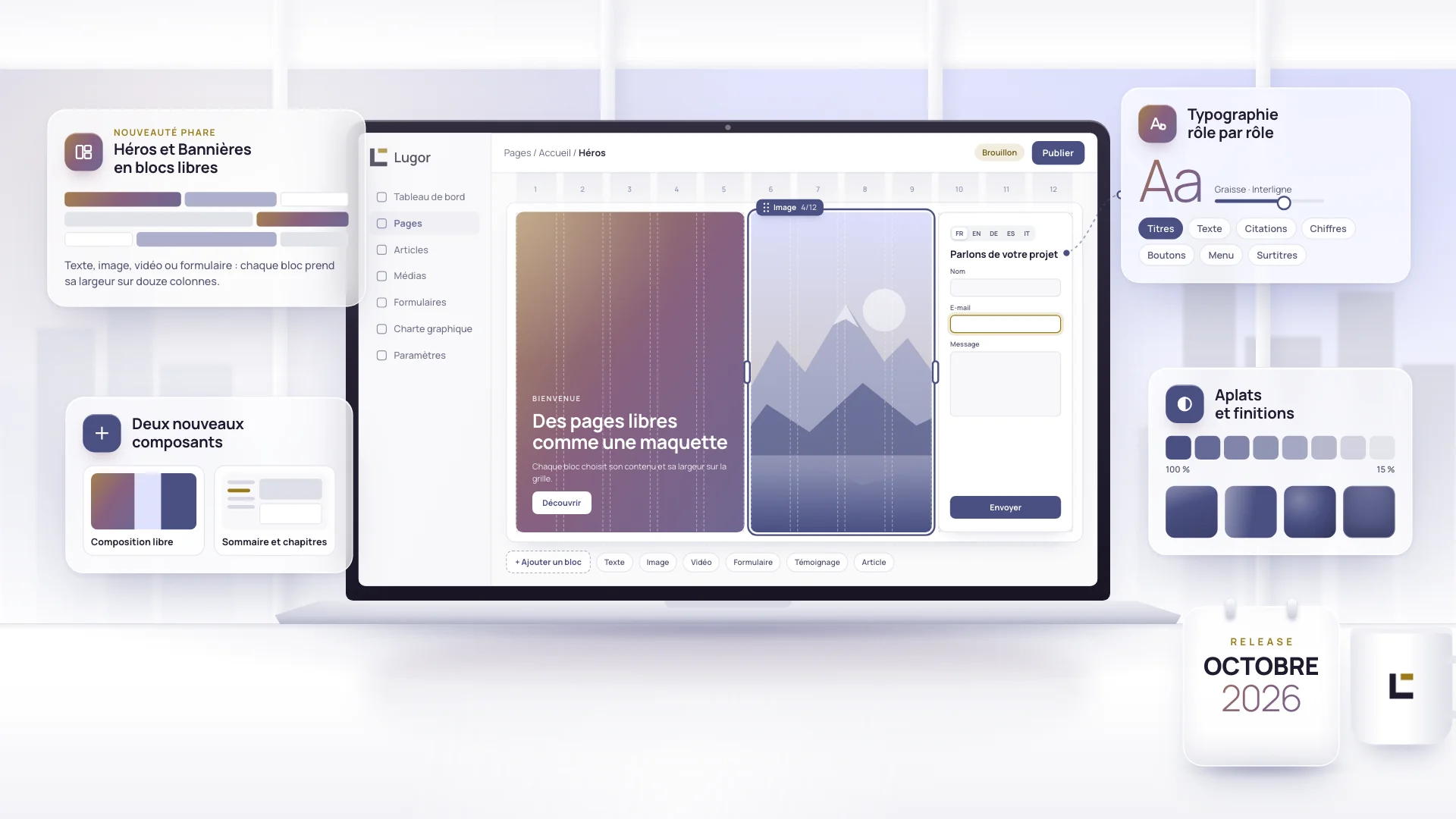
Lugor lets you build very fast sites with a layout as free as a custom build, without writing a line of code. The October release pushes that freedom further: your Heroes and Banners are built from free-form blocks, two new components arrive, and your brand guidelines now control typography role by role.
A complete web platform with Payload CMS for your clients' next sites
Lugor is built on current web best practices.
Its model grows your margin.