

You have fifteen or twenty years of experience in your field. Every week, you advise clients on the same pitfalls, you settle trade-offs that most of your peers do not master, you explain principles that shape your practice. And on your website? A page title says "30 years of experience, recognized expertise." Nothing else. Meanwhile, a less experienced peer who shows up in Google results and gets cited by AI assistants receives the inquiries your site fails to capture. Your expertise exists. Your site does not show it.
A Site Without Content Is No Longer Enough to Carry Expertise
A classic professional showcase site sums up credibility in a few assertions: "30 years of experience. Recognized expertise. Trusted firm." These claims are sincere. They remain claims, with no demonstration a visitor or a machine can access. Google and AI assistants such as Perplexity do not cite a site because it claims to be competent. They cite it because structured content demonstrates it by explaining a case, a principle or a method.
The problem is not your expertise. It is that your expertise does not produce raw material for authority. It stays buried in your advisory conversations, your internal archives, your memory. Until it becomes citable content, it is invisible to search engines and to AI. A potential client types "how do I choose between these two tax structures?" or "what are the most common pitfalls in commercial real estate?" You could advise them for an hour. But Google does not know you can.
The Raw Material Already Exists in Your Daily Practice
Every day you produce the material for authority content, often without formalizing it. The questions you handle in client emails. The clarifications you repeat on every new file. The mistakes you see made regularly. The gray-area judgment calls where your view differs from your peers'.
Four sources feed this raw material. First, your client conversations: the questions that keep coming back, the misunderstandings you have to unpack, the hidden stakes no one sees. Second, long emails: the ones where you explain a principle, make a diagnosis, recommend an approach. Third, your internal training sessions, if you run any: the outline of a training is an architecture of thought, a logic. Finally, your case law or solved cases, anonymized: the lesson you drew from a complex situation.
A firm leader with ten or twenty years in practice typically accumulates twenty or thirty of them, without always realizing it. That is enough to fuel twelve months of publishing if the material is well organized.
Structure the Material for Google AND for AI
Authority content that works for both classic search engines and AI assistants follows three simple rules.
First, favor the in-depth article that explains a principle over disconnected rules. AI assistants cite what they have understood holistically, not an isolated list of tips. An article that explains how to structure a complex decision, step by step, showing the pitfalls and the criteria to keep in mind, stays citable.
Next, structure the FAQ with standard technical markup that tells AI engines the question, the answer and the author (a format recognized by Google and Perplexity). Questions must be precise: "What is an apport-cession and when should you choose it?" rather than "What are the types of contribution?" This structure places your answer among those that voice searches and AI assistants cite first.
Finally, document the figures, principles and signatures that come up often as reusable templates across the site. Once you have written "the three criteria of a good tax structure," reuse that sentence and link to the source article. AI engines understand there is a single source of truth and cite it.
The Limits of Outsourcing to a Provider Who Doesn't Know Your Field
Many experts delegate content writing to an agency or a generalist provider. The result is typically this: a grammatically correct text that follows SEO best practices but has no edge. It lacks the angle that would make it recognizable and the nuance that would make the difference in reading.
The reason lies in the source of the content. An outside writer has never had the conversation with a client on this subject. They do not know where the real questions hide. They cannot tell the classic case in a way that resonates. Content produced under these conditions can be reproduced by any competitor. It is not a problem of effort, it is a problem of origin. When the raw material comes from the firm leader and the writing is entrusted to a provider, that provider must preserve the professional's perspective. The generic structure often takes over again when that perspective is not explicitly defended.
A Realistic Pace for a Busy Firm Leader
One well-structured article a month is enough to make your expertise visible. That comes to four hours of work, broken down: one hour to distill your know-how into key points, two hours to write or have written an in-depth article, one hour for the FAQ and the reusable templates.
The deciding factor is not quantity; it is consistency over time and the quality of the structure. One article a month for two years makes twenty-four pieces on precise questions in your field. Google and AI assistants end up identifying your site as a reliable source. By contrast, one poorly structured article a week, drowned in generic material, does not build that recognition.
The Role of the Site: Make Content Navigable and Citable
Your expertise is visible only if your site makes it accessible in three ways at once: for classic search engines (crawlable content, structured with headings, clear metadata), for AI assistants (factual answers, attributed citations, standard schema in place), and for your prospects (readable content, clear hierarchy, a frictionless path to the commercial action).
A professional site built for authority offers blocks that structure authority content in a unified way. Your articles share a common architecture. Your FAQs are indexed in a dedicated block that is compatible with AI assistants. Your certifications, your signatories, your key figure ("25 years of experience" + source) appear everywhere from a single source of truth. The AI assistant of a potential client who queries your site gets direct access to factual answers. Google understands who wrote what and when, and so cites your expertise with more confidence.
This is where the difference is made. An ordinary professional site hosts claims and hopes to rank in a search engine. A site built for authority hosts structured knowledge, immediately navigable by humans and machines alike, and has the advantage of being truly visible. A platform designed for this purpose makes that structuring native, with no technical tinkering or custom development: discover how Lugor organizes editorial autonomy and supports your drive to build authority that search engines and AI recognize.
Make Your Site and Content Visible Online with Lugor
If you want to turn your know-how into a steady flow of qualified prospects without reinventing everything, discover the Lugor features designed for expertise content or browse the full overview. To talk about structuring your expertise and the editorial overhaul of your site, book a meeting through the contact page and get a reply within 48 hours.
Key takeaways
- Your professional site asserts your expertise without proving it: "30 years of experience" is only citable if content demonstrates it.
- Google and AI cite what is structured and explained, not what is asserted.
- You produce the raw material every day without knowing it: recurring client questions, long emails, internal training and solved cases add up to at least twelve articles a year.
- Structuring for LLMs is not costly: article + standard FAQ schema + reusable templates for certifications and key figures.
- One article a month with distinctive content beats four generic articles a month.
- Outsourcing to an agency with no expertise in your field produces content that can be plagiarized, and is therefore useless for visibility.
- A site built for authority hosts knowledge in a way that is navigable for your prospects, for AI and for search engines.
Frequently asked questions
Glossary
- Authority content
- Content that demonstrates competence by explaining a principle, a case or a method, rather than by a simple claim. Used and cited by search engines and AI assistants as a reliable source.
- Raw material
- All the questions, cases, issues and mistakes you handle daily that can become content. An unstructured internal source, drawn from your client conversations or your archives.
- Standard schema
- A technical vocabulary (schema.org) for structuring factual information (FAQ, address, article, reviews) so that AI assistants and search engines understand it precisely and cite it correctly.
- Single source of truth
- One official version of a piece of information (your certificate, your key figure, your signature) that the site links to everywhere. It ensures consistency and helps AI assistants cite accurately.
- Crawlable
- Content that search engines can read and index. It requires a clear structure (headings, metadata, internal links).
- LLM / AI
- An AI model such as ChatGPT, Perplexity, Gemini or Claude that generates text. These models cite sources when they find them structured and factual.
Sources
- Backlinko, "Google's 2024 Core Update Impact on Expertise and Content Quality", 2024. E-E-A-T trend (Expertise, Experience, Authoritativeness, Trustworthiness) in Google's criteria.
- Moz Blog, "How AI Models Find and Cite Sources", 2025. Analysis of the citation criteria of AI assistants and of content structuring.
- HubSpot Research, "Authority Content and Lead Generation for Professional Services", 2025. Data on the role of specialized content in generating qualified prospects.
- Semrush, "Expert-Written vs AI-Written Content: Impact on Search Rankings", 2024. Comparison of the performance of expert-written content versus generic content.
- OpenAI, "How to Optimize Content for Citation in Large Language Models", 2024. Guide to structuring content for citation by AI assistants.
Related articles
 Release notes
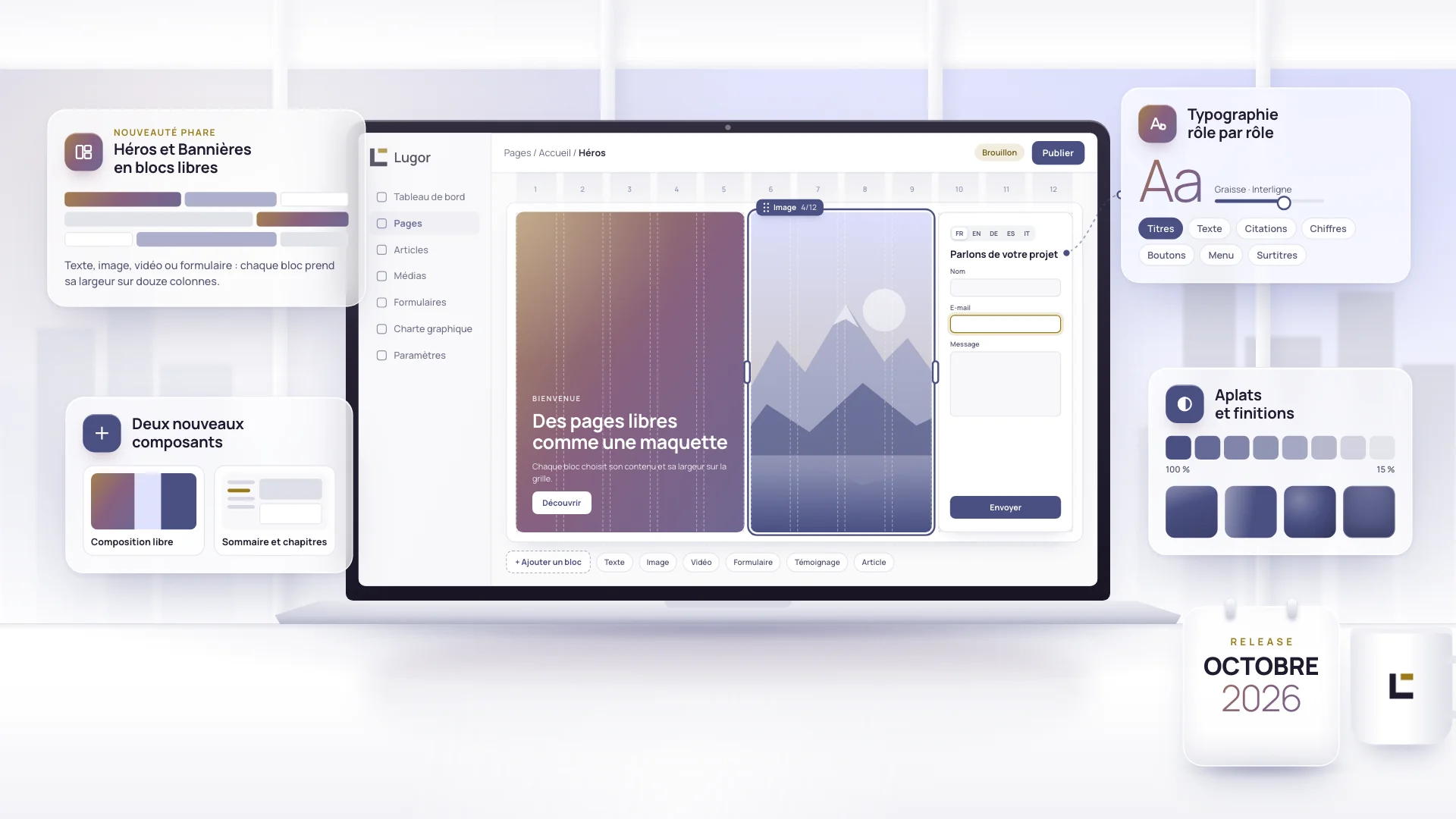
What's new in Lugor: October 2026
Lugor lets you build very fast sites with a layout as free as a custom build, without writing a line of code. The October release pushes that freedom further: your Heroes and Banners are built from free-form blocks, two new components arrive, and your brand guidelines now control typography role by role.
 Release notes
What's new in Lugor: September 2026
On the menu for this release: better ergonomics and simpler, unified use, to keep pushing further toward one of the most polished no-code building platforms on the market.
 Release notes
What's new in Lugor: August 2026
Lugor's August 2026 updates: richer Hero block, page composition in sections and columns, new Testimonials block, more flexible modals and media.